Nas.io • AI Cofounder
Transforming ideas into sellable products with AI
Role
Lead Product Designer
Design QA
Collaborators
Founder/CEO
2 Engineers
PM + PD
Timeline
Jun-Jul 2025
7 Weeks
Impact
We transformed how creators launch products in 60 days
60 days after launch, AI Cofounder became the primary way creators build on Nas.io—fundamentally changing the platform's product creation experience and driving significant revenue growth.
83%
83%
of new products created using AI Cofounder
100K+
100K+
AI Cofounder users
$2.4M
$2.4M
ARR generated in 2 months (paid feature)
Background
Nas.io is an all-in-one digital business platform
Nas.io is an all-in-one platform helping 500,000+ creators launch digital products, courses, events, coaching, memberships, without technical expertise or design skills. It's designed to be simple to use and fast to set up.
But even with accessible tools, most creators struggle to turn ideas into action. They face decision paralysis: What should I price this? Who's my audience? What should the landing page say? AI Cofounder solves this by acting as a true business partner, generating everything needed to launch from a single conversational input.
Background
Nas.io is an all-in-one digital business platform
Nas.io is an all-in-one platform helping 500,000+ creators launch digital products, courses, events, coaching, memberships, without technical expertise or design skills. It's designed to be simple to use and fast to set up.
But even with accessible tools, most creators struggle to turn ideas into action. They face decision paralysis: What should I price this? Who's my audience? What should the landing page say? AI Cofounder solves this by acting as a true business partner, generating everything needed to launch from a single conversational input.
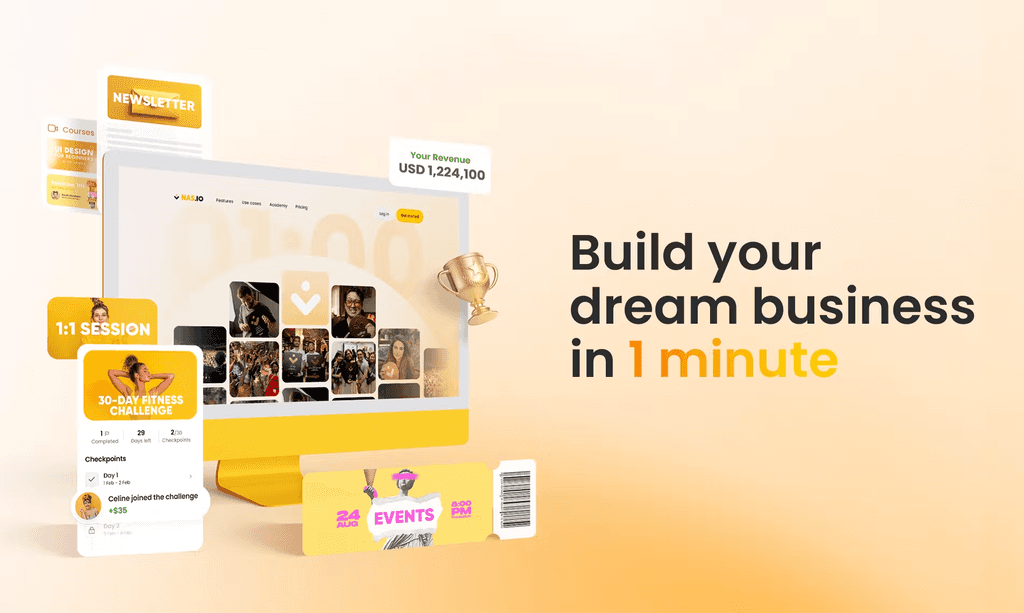
Problem
90% of ideas die from decision paralysis
Creators have ideas but struggle to validate them. Traditional digital product builder force users through 50+ decisions: What's your product name? How much should you charge? What should the landing page say? Who's your target audience?
By the time they finish, momentum is lost. Most ideas die before reaching a single customer.
Problem
90% of ideas die from decision paralysis
Creators have ideas but struggle to validate them. Traditional digital product builder force users through 50+ decisions: What's your product name? How much should you charge? What should the landing page say? Who's your target audience?
By the time they finish, momentum is lost. Most ideas die before reaching a single customer.
Opportunity
Eliminate decision paralysis by having AI make confident decisions first, then let users react and refine.
Opportunity
Eliminate decision paralysis by having AI make confident decisions first, then let users react and refine.
Final Solution
Imagine. Create. Earn. From one sentence to complete product launch.
Users describe their business idea with plain language. The AI analyzes their input, matches it to the right product type, and generates:
Complete landing page with pricing, copy, and structure
3 ad creatives ready to launch through Magic Ads
20 qualified leads sourced through Magic Leads
Personalized outreach email templates
Final Solution
Imagine. Create. Earn. From one sentence to complete product launch.
Users describe their business idea with plain language. The AI analyzes their input, matches it to the right product type, and generates:
Complete landing page with pricing, copy, and structure
3 ad creatives ready to launch through Magic Ads
20 qualified leads sourced through Magic Leads
Personalized outreach email templates
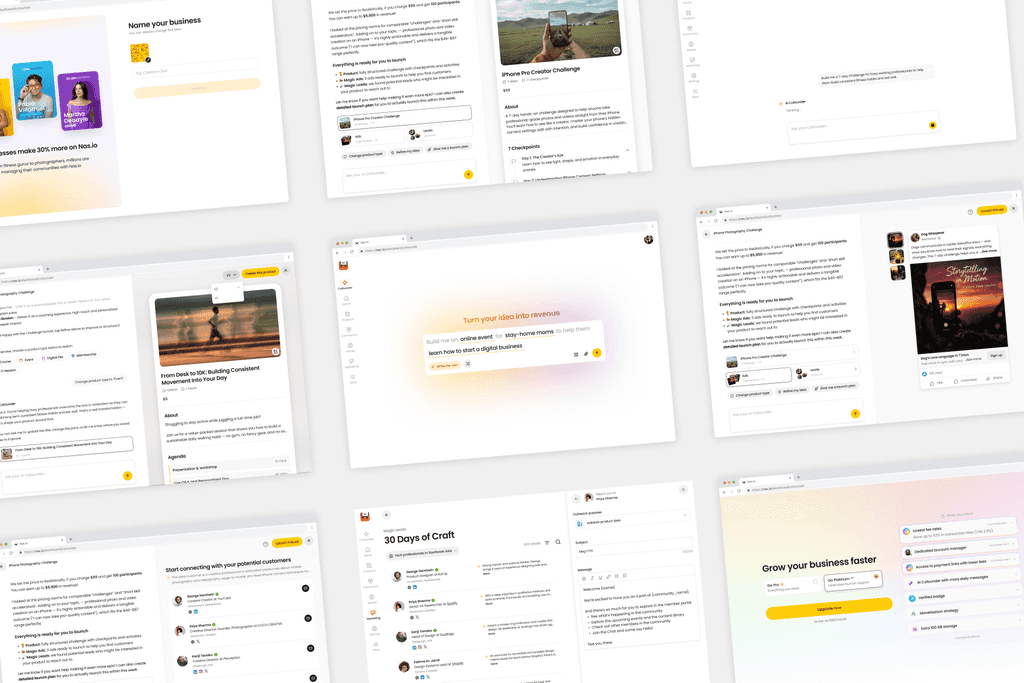

Integrates with marketing features to cover the full customer journey
Distribution and cold start was a common problem we identified in the customers' journey to sell a product. We integrates with marketing features to cover the full customer journeyThe AI integrates seamlessly with Nas.io's marketing features. One conversation creates the product and connects users directly to customer acquisition tools.
Integrates with marketing features to cover the full customer journey
Distribution and cold start was a common problem we identified in the customers' journey to sell a product. We integrates with marketing features to cover the full customer journeyThe AI integrates seamlessly with Nas.io's marketing features. One conversation creates the product and connects users directly to customer acquisition tools.
My Role
Designing across 3 layers
Interface Layer: Designed the conversational UI, product preview states, editing flows, and all output components users interact with (covered above).
Intelligence Layer: Collaborated with PM to define how AI understands intent and makes decisions. Contributed to system prompts that control AI personality, reasoning steps, and output format.
Knowledge Layer: Restructured help documentation into AI-readable chunks for contextual support through RAG retrieval.
Each layer needed to work seamlessly together. The interface showed what the AI generated, the intelligence determined what to generate, and the knowledge enabled the AI to teach users what they created.
My Role
Designing across 3 layers
Interface Layer: Designed the conversational UI, product preview states, editing flows, and all output components users interact with (covered above).
Intelligence Layer: Collaborated with PM to define how AI understands intent and makes decisions. Contributed to system prompts that control AI personality, reasoning steps, and output format.
Knowledge Layer: Restructured help documentation into AI-readable chunks for contextual support through RAG retrieval.
Each layer needed to work seamlessly together. The interface showed what the AI generated, the intelligence determined what to generate, and the knowledge enabled the AI to teach users what they created.
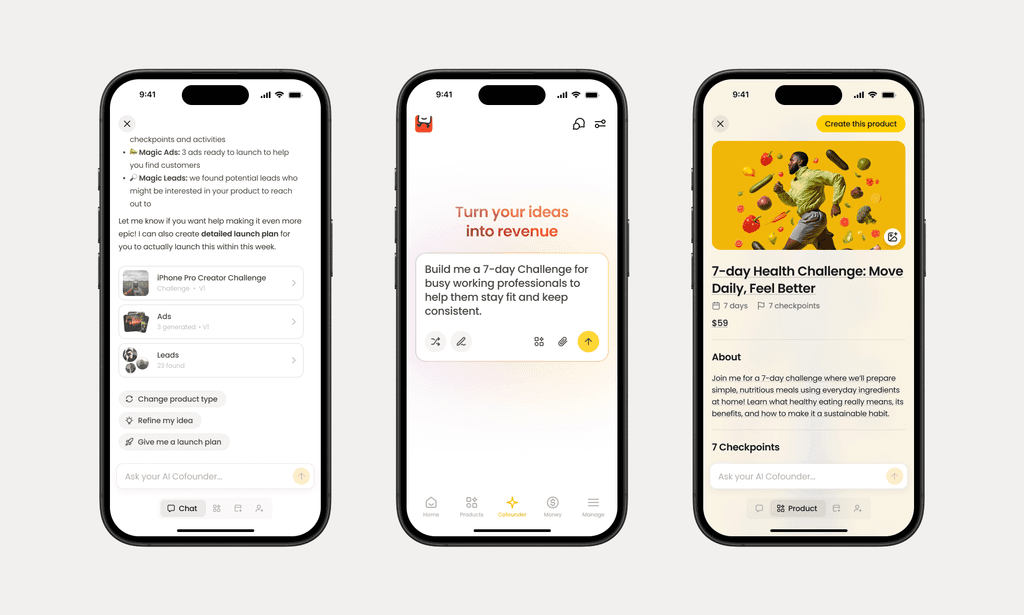
Explorations
Designing behaviour
Approach 1: Pixel-Perfect Product Previews Show the exact landing page layout for each product type. Users see precisely what their customers would see.
Challenge: Every product type (events, courses, challenges) had different landing page structures. Supporting all variations would exponentially increase development complexity.
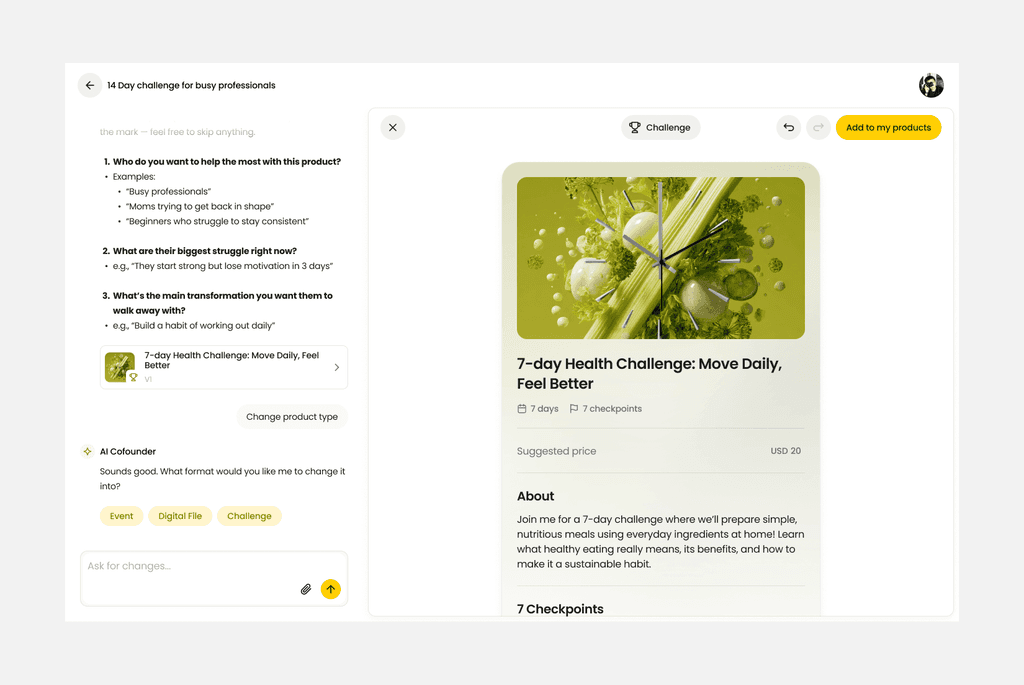
Approach 2: Unified Abstraction Layer Abstract all product types into a consistent editing interface. Sacrifice pixel-perfect preview for development efficiency and consistency.
Trade-off: Users don't see the exact landing page, but gain a unified editing experience that works across all product types. This became our chosen approach.
Explorations
Designing behaviour
Approach 1: Pixel-Perfect Product Previews Show the exact landing page layout for each product type. Users see precisely what their customers would see.
Challenge: Every product type (events, courses, challenges) had different landing page structures. Supporting all variations would exponentially increase development complexity.
Approach 2: Unified Abstraction Layer Abstract all product types into a consistent editing interface. Sacrifice pixel-perfect preview for development efficiency and consistency.
Trade-off: Users don't see the exact landing page, but gain a unified editing experience that works across all product types. This became our chosen approach.
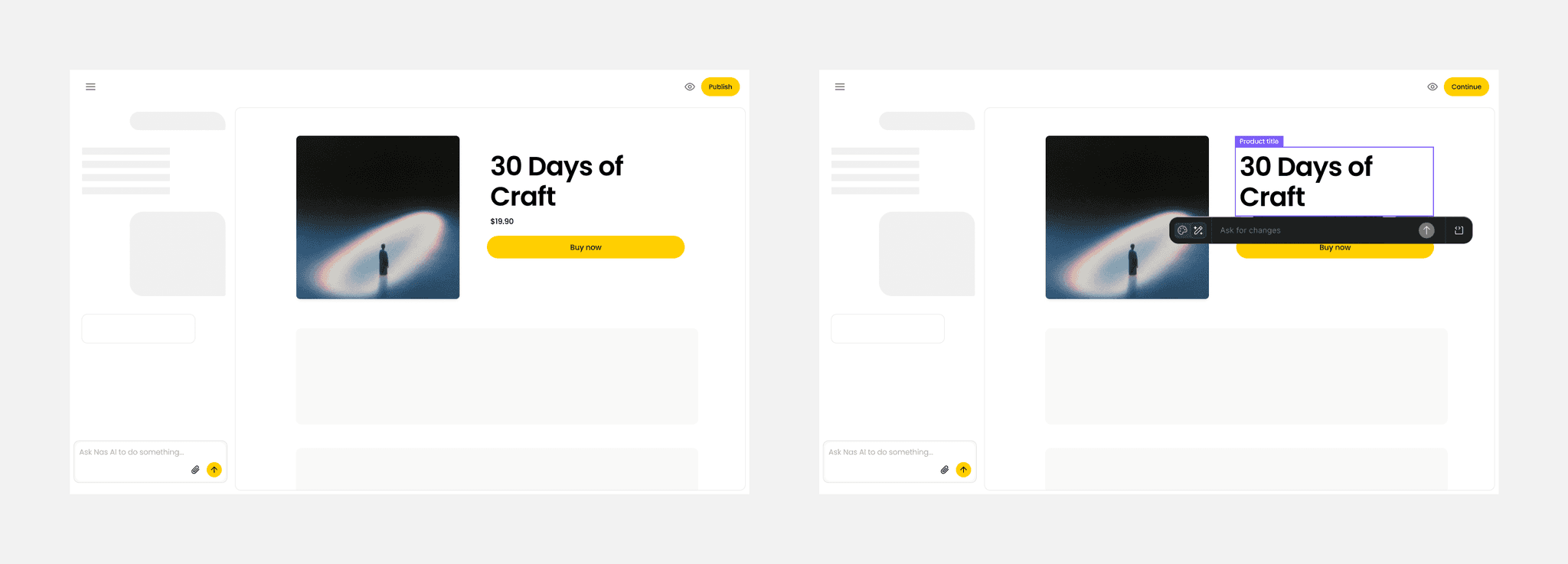
Approach 3: AI-Generated Block System Remove product types entirely. Let AI configure the optimal "blocks" (pricing, description, agenda, etc.) for each unique idea.
Why we didn't pursue this: Too ambitious for our timeline and technical capability. Would require building an entirely new content management system.
The Decision We chose Approach 2—a unified abstraction layer that balanced user needs with engineering constraints. This led us to focus scope on idea creation and generation, narrowing the user flow to:
Prompt → Response + Product Created → Refine → Publish
This constraint actually improved the experience—users focused on their idea rather than wrestling with page layouts.
Approach 3: AI-Generated Block System Remove product types entirely. Let AI configure the optimal "blocks" (pricing, description, agenda, etc.) for each unique idea.
Why we didn't pursue this: Too ambitious for our timeline and technical capability. Would require building an entirely new content management system.
The Decision We chose Approach 2—a unified abstraction layer that balanced user needs with engineering constraints. This led us to focus scope on idea creation and generation, narrowing the user flow to:
Prompt → Response + Product Created → Refine → Publish
This constraint actually improved the experience—users focused on their idea rather than wrestling with page layouts.
Nas.io • AI Cofounder
Transforming ideas into sellable products with AI
Role
Lead Product Designer
Design QA
Collaborators
Founder/CEO
2 Engineers
PM + PD
Timeline
Jun-Jul 2025
7 Weeks
Impact
We transformed how creators launch products in 60 days
60 days after launch, AI Cofounder became the primary way creators build on Nas.io—fundamentally changing the platform's product creation experience and driving significant revenue growth.
83%
of new products created using AI Cofounder
100K+
AI Cofounder users
$2.4M
ARR generated in 2 months (paid feature)
Background
Nas.io is an all-in-one digital business platform
Nas.io is an all-in-one platform helping 500,000+ creators launch digital products, courses, events, coaching, memberships, without technical expertise or design skills. It's designed to be simple to use and fast to set up.
But even with accessible tools, most creators struggle to turn ideas into action. They face decision paralysis: What should I price this? Who's my audience? What should the landing page say? AI Cofounder solves this by acting as a true business partner, generating everything needed to launch from a single conversational input.
Problem
90% of ideas die from decision paralysis
Creators have ideas but struggle to validate them. Traditional digital product builder force users through 50+ decisions: What's your product name? How much should you charge? What should the landing page say? Who's your target audience?
By the time they finish, momentum is lost. Most ideas die before reaching a single customer.
Opportunity
Eliminate decision paralysis by having AI make confident decisions first, then let users react and refine.
Final Solution
Imagine. Create. Earn. From one sentence to complete product launch.
Users describe their business idea with plain language. The AI analyzes their input, matches it to the right product type, and generates:
Complete landing page with pricing, copy, and structure
3 ad creatives ready to launch through Magic Ads
20 qualified leads sourced through Magic Leads
Personalized outreach email templates
Integrates with marketing features to cover the full customer journey
Distribution and cold start was a common problem we identified in the customers' journey to sell a product. We integrates with marketing features to cover the full customer journeyThe AI integrates seamlessly with Nas.io's marketing features. One conversation creates the product and connects users directly to customer acquisition tools.
My Role
Designing across 3 layers
Interface Layer: Designed the conversational UI, product preview states, editing flows, and all output components users interact with (covered above).
Intelligence Layer: Collaborated with PM to define how AI understands intent and makes decisions. Contributed to system prompts that control AI personality, reasoning steps, and output format.
Knowledge Layer: Restructured help documentation into AI-readable chunks for contextual support through RAG retrieval.
Each layer needed to work seamlessly together. The interface showed what the AI generated, the intelligence determined what to generate, and the knowledge enabled the AI to teach users what they created.
Explorations
Designing behaviour
Approach 1: Pixel-Perfect Product Previews Show the exact landing page layout for each product type. Users see precisely what their customers would see.
Challenge: Every product type (events, courses, challenges) had different landing page structures. Supporting all variations would exponentially increase development complexity.
Approach 2: Unified Abstraction Layer Abstract all product types into a consistent editing interface. Sacrifice pixel-perfect preview for development efficiency and consistency.
Trade-off: Users don't see the exact landing page, but gain a unified editing experience that works across all product types. This became our chosen approach.
Approach 3: AI-Generated Block System Remove product types entirely. Let AI configure the optimal "blocks" (pricing, description, agenda, etc.) for each unique idea.
Why we didn't pursue this: Too ambitious for our timeline and technical capability. Would require building an entirely new content management system.
The Decision We chose Approach 2—a unified abstraction layer that balanced user needs with engineering constraints. This led us to focus scope on idea creation and generation, narrowing the user flow to:
Prompt → Response + Product Created → Refine → Publish
This constraint actually improved the experience—users focused on their idea rather than wrestling with page layouts.